The Hidden Cost of “It’ll Work When We Get There”
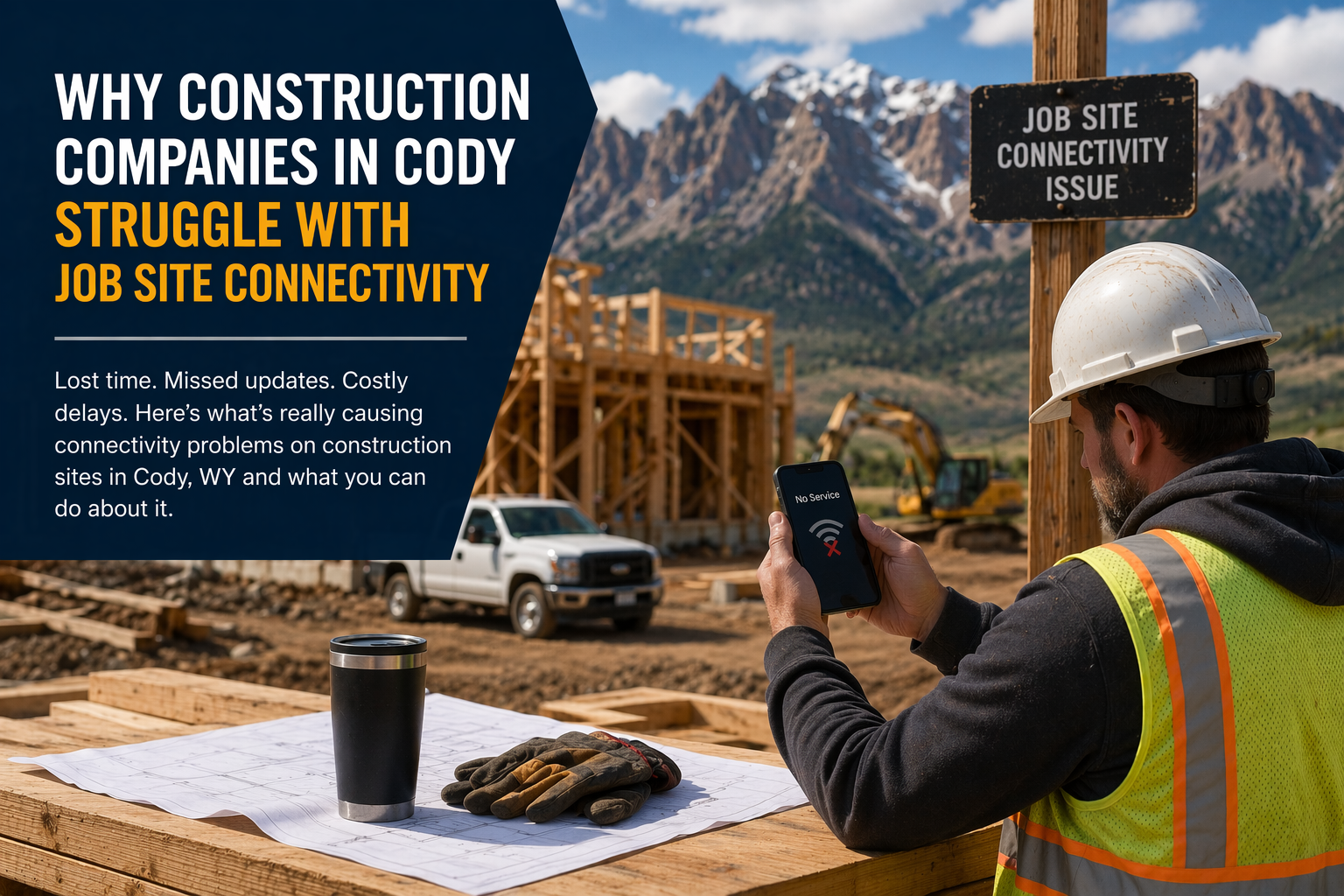
In a place like Cody, construction doesn’t happen in controlled environments. It happens on open land, in developing subdivisions, on the outskirts of town, and often miles outside reliable infrastructure. That’s part of what makes building here unique. It’s also what quietly creates one of the biggest operational headaches for construction companies.
Job site connectivity.
Most construction companies don’t think about internet and network reliability until it becomes a problem. The assumption is simple. Phones will work. Hotspots will cover it. Someone can always drive back into town if needed. On paper, that sounds manageable. In reality, it creates daily friction that chips away at productivity, communication, and ultimately profit.
Crews show up ready to work, but plans are not loading. Supervisors need to check updated drawings, but the file will not open. Project managers are waiting on confirmations, but messages are delayed or missed entirely. Equipment deliveries get rescheduled because someone could not confirm timing. Small delays stack up fast.
In a tight margin industry like construction, those delays matter more than most realize.
The real issue is not just “bad internet.” It is the gap between how construction companies operate today and the infrastructure supporting them. Modern construction relies heavily on cloud-based tools, real-time communication, digital documentation, and coordination between teams. When connectivity fails, the entire system slows down.
In Cody, that gap is more pronounced than in larger metro areas. Terrain, infrastructure limitations, and job site variability all play a role. But the bigger issue is that most companies have not built a strategy around it.
They are reacting instead of planning.
And that’s where the real cost starts to show.
What’s Actually Happening on Job Sites in Cody
If you spend time around construction companies in Cody, you will hear the same frustrations over and over again. Crews dealing with spotty cell service. Project managers juggling phone calls because apps will not load. Office teams waiting on updates that should have been instant.
This is not a one-off issue. It is a consistent operational problem.
Most job sites rely on one of three things. Personal cell service, mobile hotspots, or nothing at all. Each option has limitations, especially in a region like Cody where coverage can vary dramatically even within a few miles.
Cell service might be strong at the front of a property and nonexistent in the back. A hotspot might work in the morning and fail in the afternoon when more devices connect. Some sites are simply outside reliable coverage zones altogether.
At the same time, construction companies are using more technology than ever before. Project management platforms, scheduling tools, time tracking apps, digital blueprints, and communication systems are now standard. These tools are designed for constant connectivity.
When that connection is unreliable, everything breaks down.
Instead of seamless communication, teams fall back to phone calls and text messages. Instead of real-time updates, information is delayed or lost. Instead of accurate reporting, data becomes fragmented and inconsistent.
This creates a disconnect between the field and the office.
The office assumes the field has access to the same information. The field assumes the office understands the limitations on site. Neither side is entirely wrong, but the gap between them grows wider with every missed update.
In Cody, this issue is amplified by geography and scale. Construction projects often stretch across large areas with uneven terrain. Trees, hills, and distance from towers all impact signal strength. Seasonal factors can also play a role, with weather affecting reliability in ways that are hard to predict.
The result is a working environment where connectivity is inconsistent at best and nonexistent at worst.
And most companies are simply trying to work around it instead of fixing it.
Why This Matters More Than Most Business Owners Realize
At first glance, connectivity issues might seem like an inconvenience. Something crews deal with as part of the job. But when you break it down, the impact is far more serious.
Time is the most obvious cost.
Every time a crew waits for a file to load, drives to find service, or pauses work to confirm details, time is lost. Those minutes turn into hours over the course of a week. Across multiple crews and projects, that adds up quickly.
Labor is one of the highest costs in construction. Wasting even a small percentage of that time directly impacts your bottom line.
Communication breakdowns are the next major issue.
When teams cannot communicate clearly and consistently, mistakes happen. Plans get misread. Changes are not implemented. Deliveries are missed. These are not small problems. They can lead to rework, delays, and strained relationships with clients.
Rework is especially costly.
Fixing something that was done incorrectly due to outdated or missing information is far more expensive than doing it right the first time. Connectivity issues increase the likelihood of these mistakes because teams are not always working from the most current data.
There is also a leadership impact.
Project managers and business owners lose visibility into what is happening on site. Without reliable data and communication, decision-making becomes reactive instead of proactive. You are solving problems after they happen instead of preventing them.
That limits your ability to scale.
A construction company that cannot maintain consistent communication and data flow across job sites will struggle to grow. Adding more projects increases complexity, and without the right systems in place, that complexity becomes unmanageable.
There is also a client experience component.
Clients expect updates. They expect timelines to be met. They expect professionalism. When communication is delayed or inconsistent, it affects their perception of your business. Even if the work itself is high quality, the experience can feel disorganized.
In a market like Cody, where reputation matters and word travels fast, that can have long-term consequences.
Finally, there is a competitive angle.
Construction companies that solve these issues gain a significant advantage. They move faster, communicate better, and operate more efficiently. Over time, that translates into higher margins, better client relationships, and more opportunities.
Connectivity is no longer a “nice to have.” It is a core part of running a modern construction business.
Ignoring it is not neutral. It is costly.
The Real Reasons Job Site Connectivity Fails
Most companies assume connectivity issues are just part of being in a rural area. While geography does play a role, the root causes are usually more specific and more solvable than people think.
The first issue is reliance on consumer-grade solutions.
Hotspots and personal devices are not designed for the demands of a job site. They are built for individual use, not for multiple devices, large file transfers, or constant uptime. When several team members rely on a single hotspot, performance drops quickly.
The second issue is lack of planning.
Connectivity is rarely considered during the planning phase of a project. It is treated as an afterthought. By the time problems show up, the job is already underway, and options are limited.
The third issue is inconsistent infrastructure.
Not all job sites are equal. Some may have strong coverage from one carrier but not another. Others may be in complete dead zones. Without testing and planning, companies are essentially guessing.
The fourth issue is lack of redundancy.
Most setups rely on a single connection method. When that method fails, there is no backup. In a business where downtime is expensive, relying on a single point of failure is a risk.
The fifth issue is device and network management.
Even when connectivity is available, poorly managed devices and networks can create problems. Outdated equipment, lack of security, and improper configuration can all impact performance.
Finally, there is a knowledge gap.
Many construction companies do not have in-house IT expertise. They are experts in building, not in network infrastructure. That means decisions about connectivity are often made without a full understanding of the options or the risks.
The good news is that these problems are not permanent.
They are solvable with the right approach.
Practical Ways to Improve Job Site Connectivity
Improving connectivity does not require overcomplicating your business. It requires being intentional.
The first step is assessing each job site before work begins.
Understand the coverage in that area. Test different carriers. Identify potential dead zones. This allows you to plan instead of react.
The second step is using business-grade equipment.
Dedicated mobile routers and managed connectivity solutions perform far better than consumer hotspots. They are designed to handle multiple devices and provide more stable connections.
The third step is building redundancy.
Do not rely on a single connection. Use multiple carriers or backup systems so that if one fails, another takes over. This reduces downtime significantly.
The fourth step is optimizing how your team uses technology.
Not every task needs to happen in real time. Some systems can be configured to sync when a connection is available. Training your team on how to work efficiently in low-connectivity environments can make a big difference.
The fifth step is securing your network.
Job sites are often overlooked when it comes to security. Using secure connections and properly managed devices protects your data and ensures consistent performance.
The sixth step is centralizing your systems.
When your tools and platforms are integrated and managed properly, they require less bandwidth and are easier to maintain. This reduces the strain on your connection and improves reliability.
Finally, it is important to have a support system in place.
When something goes wrong, you need a fast response. Waiting hours or days for a fix is not acceptable when crews are on site and work is on hold.
This is where having a local IT partner becomes valuable.
When It’s Time to Bring in Help
There is a point where trying to manage connectivity internally starts to cost more than it saves.
If your team is consistently dealing with delays, communication issues, or unreliable systems, that is a signal. If project managers are spending time troubleshooting instead of managing projects, that is another.
When technology becomes a bottleneck instead of a tool, it is time to reevaluate.
A professional IT partner can assess your current setup, identify gaps, and design a solution that fits your specific needs. This is not about adding complexity. It is about removing friction.
In a place like Cody, local expertise matters.
An IT company that understands the area, the terrain, and the unique challenges of construction in this region can provide solutions that actually work. They can recommend the right carriers, the right equipment, and the right setup for your job sites.
They can also provide ongoing support.
When something breaks, you need it fixed quickly. Fast response times and reliable service make a significant difference in keeping your projects on track.
The goal is not to turn your construction company into a tech company.
The goal is to make technology work so well that you do not have to think about it.
A Smarter Way to Run Construction Projects in Cody
Construction in Cody is not getting simpler. Projects are becoming more complex. Client expectations are increasing. Technology is becoming more integrated into every part of the process.
Connectivity is a foundational piece of that shift.
Companies that address it head-on will operate more efficiently, communicate more effectively, and position themselves for growth. Those that ignore it will continue to deal with delays, frustration, and missed opportunities.
At Arsenal Dev, we work with businesses across Cody to solve exactly these kinds of problems.
We understand that you are not looking for complicated solutions. You are looking for reliability. You want your systems to work, your team to stay connected, and your projects to move forward without unnecessary interruptions.
That is what we focus on.
From job site connectivity planning to network setup, device management, and ongoing support, we help construction companies build a foundation that supports how they actually work.
No contracts. No outsourcing. Just a local team that responds quickly and gets the job done.
If you are tired of dealing with unreliable connectivity on your job sites, it might be time for a different approach.
Start with a conversation.
We will take a look at your current setup, identify where the problems are coming from, and show you what it would take to fix them.
Because in construction, delays cost money.
And the right systems can eliminate more of them than you think.


